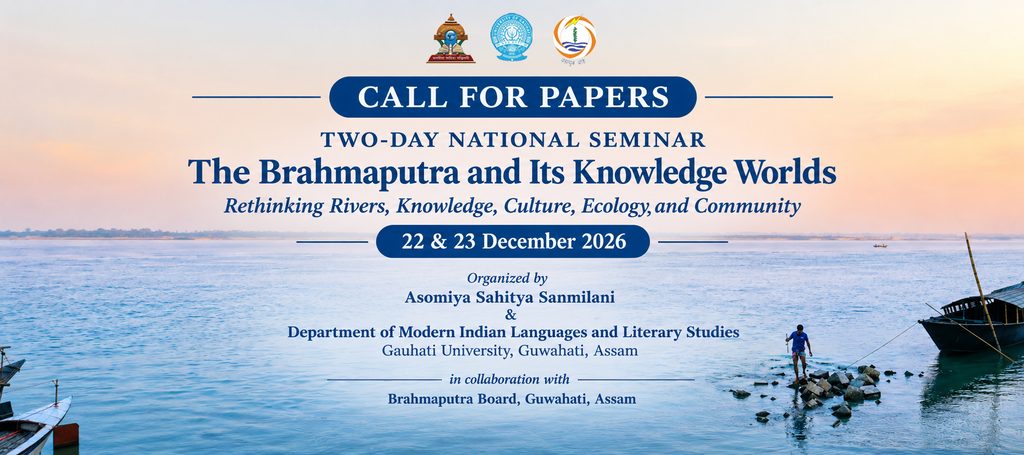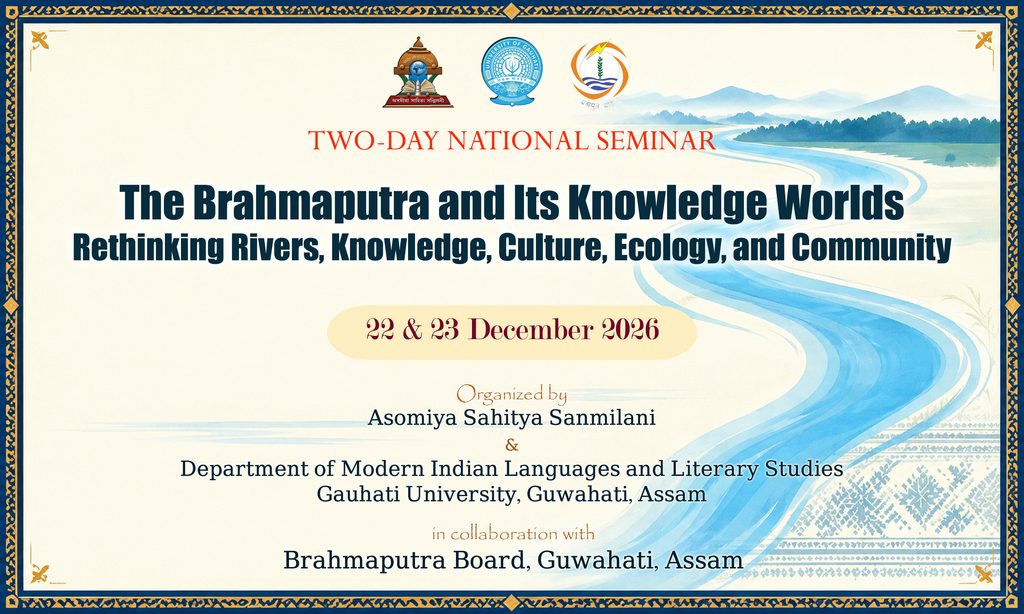
Two-Day National Seminar
The Brahmaputra and Its Knowledge Worlds: Rethinking Rivers, Knowledge, Culture, Ecology, and Community
Dates: 22 & 23 December 2026
Organized by
Asomiya Sahitya Sanmilani
&
Department of Modern Indian Languages and Literary Studies
Gauhati University, Guwahati, Assam
in collaboration with
Brahmaputra Board, Guwahati, Assam
CONCEPT NOTE
Rivers are more than geographical formations or channels of water. They are dynamic knowledge systems that shape human histories, cultures, economies, memories, belief systems, literary traditions, ecological practices and modes of inhabitation. A river generates, stores, transmits and transforms knowledge through the communities, landscapes and cultural worlds that evolve around it. The Brahmaputra provides a particularly compelling site for such an inquiry. Traversing multiple ecological and cultural landscapes and connecting diverse communities across national and regional boundaries, the river has profoundly shaped the histories, cultures and knowledge traditions of the Brahmaputra Valley. In Assam, the river is deeply embedded in everyday life, agriculture, navigation, folklore, music, literature, ritual practices, settlement patterns, migration, trade and ecological adaptation. The Brahmaputra is therefore not simply an object of knowledge; it is also a producer of knowledge. Its annual rhythms of flood and erosion, the formation and disappearance of chars and chaporis, changing river courses, aquatic biodiversity, riverine agriculture, fishing practices and community responses to environmental uncertainty have generated sophisticated forms of situated and experiential knowledge. Indigenous and local communities have developed ways of reading water, weather, soil, landscape, plants, animals and seasonal change. Such knowledge systems frequently exist outside formal institutions of knowledge production and invite us to reconsider what constitutes legitimate knowledge. At the same time, the Brahmaputra has been represented extensively in literature, folklore, oral narratives, visual culture, music, cinema, travel writing, colonial records and contemporary media. These representations reveal the river as a metaphor of memory, displacement, belonging, uncertainty, resilience and transformation.
The conference proposes to explore these multiple knowledge worlds of the Brahmaputra through an interdisciplinary dialogue between literary and cultural studies, environmental humanities, indigenous knowledge systems, history, anthropology, geography, hydrology, sociology, development studies and related fields. The central premise of the conference is that a river-centric approach can move us beyond conventional disciplinary boundaries and encourage a more holistic understanding of the relationship between water, knowledge, culture, ecology and community.
THEMATIC AREAS
- River as Knowledge System
- The Brahmaputra and Indigenous Epistemologies
- River, Literature and Cultural Imagination
- River, Memory and History
- River, Ecology and Environmental Humanities
- Riverine Communities and Everyday Life
- Flood, Erosion and Resilience
- River, Development and Governance
- Science, Technology and River Knowledge
- Translation, Language and River Knowledge
- River, Art, Cinema and Visual Culture
- Gender, Caste, Class and Riverine Knowledge
- Comparative River Studies
- Future of the Brahmaputra
- Any Other Topic related to the Main Theme of the Seminar
KEY QUESTIONS
● How can the Brahmaputra be understood as a site and source of knowledge?
● What forms of knowledge emerge from living with the river?
● How do indigenous and local communities interpret and respond to the river?
● How does the Brahmaputra shape literature, folklore, music and cultural memory?
● How have flood, erosion and displacement transformed riverine identities?
● How can indigenous knowledge and scientific knowledge enter into meaningful dialogue?
● What can a river-centric approach contribute to environmental humanities and literary studies?
● How can river-centric knowledge inform sustainable and equitable river governance?
● What would a decolonial epistemology of the Brahmaputra entail?
● How might the knowledge worlds of the Brahmaputra help us imagine alternative ecological futures?
CALL FOR PAPERS
Scholars, researchers, teachers, students, practitioners, writers, artists, environmentalists, scientists and community knowledge holders are invited to submit papers (in Assamese, Hindi, and English) engaging with the broad theme of “The Brahmaputra and Its Knowledge Worlds: Rethinking Rivers, Knowledge, Culture, Ecology and Community.” The conference particularly encourages interdisciplinary, transdisciplinary, comparative, field-based and community-engaged research.
ABSTRACT SUBMISSION
Abstracts of 250–300 words should be accompanied by:
● Title of the paper
● Name of the author(s)
● Institutional affiliation
● Email address
● Contact number
● Five keywords
● Brief biographical note of approximately 100 words
Google Form Link for submission of abstracts and other details: https://forms.gle/dmJUPeWRiXeo2xuV7
Last Date of Abstract Submission: 15th November 2026
Notification of Acceptance: 25th November 2026
Conference dates: 22nd & 23rd December 2026
REGISTRATION FEES
For Teachers, Professionals, and Salaried Persons: Rs 1700
For Research Scholars: Rs 1200
For Students: Rs 800
MODE: Offline
Venue: Dept of MIL & Literary Studies, Gauhati University, Guwahati, Assam
PUBLICATION
Selected papers may be considered for publication in a peer-reviewed edited volume or journal, subject to the applicable editorial and peer-review processes.
CONTACT
Dr. Dhurjjati Sarma, Coordinator ([email protected] / 7002107621)
Department of Modern Indian Languages and Literary Studies, Gauhati University, Guwahati, Assam
Dr. Bhaskar Bhuyan, Assistant Coordinator ([email protected] / 8751943387)
Chief Secretary, Asomiya Sahitya Sanmilani, Assam
Chairperson: Prof. Anuradha Sarma, Professor & Head, Department of Modern Indian Languages and Literary Studies, Gauhati University, Guwahati, Assam
Board of Advisors:
Dr. Ranbir Singh, IAS (Retd.), Chairman, Brahmaputra Board, Basistha, Guwahati
Prof. Mukul Chakravarty, President, Asomiya Sahitya Sanmilani, Guwahati, Assam
Prof. Dilip Borah, Professor & Former Head, Department of Modern Indian Languages and Literary Studies, Gauhati University, Guwahati, Assam